
Home » Diseases » Emergencies / First Aid for Dogs & Cats – General Information » Emergencies / First Aid A-Z » Eyeball prolapse (Bulbusprolaps)
Eyeball prolapse (Bulbusprolaps)
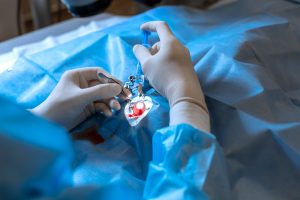
Surgical removal of a prolapsed eyeball (bulbusextierpation)

Healed bulbusextierpation in a Cocker Spaniel puppy
You might also be interested in:
Definition
Eyeball prolapse (Bulbusprolaps) dog/cat
A Bulbusprolaps is the protrusion of the eyeball from the orbital cavity, usually after trauma or by strong tensile forces on the head, especially in brachycephalic breeds. The eyelid apparatus, optic nerve and blood supply are endangered. This is an ophthalmological emergency with a high risk of permanent damage.
Eyeball prolapse, medically referred to as Bulbusprolaps or Proptosis bulbi, is an acute ophthalmological emergency in which the eyeball is displaced forward from its normal position in the orbital cavity (Orbita). The eyelids are trapped behind the eyeball, which prevents spontaneous sliding back. Anatomically, the eyeball is normally held in its position by several structures: the extraocular muscles, the optic nerve, the conjunctiva, and the retrobulbar fatty tissue. In a Bulbusprolaps, these holding structures are overstretched or even torn. The conjunctiva and cornea are then exposed to the environment unprotected, which can quickly lead to dehydration and further damage. This condition requires immediate veterinary treatment, as any delay significantly worsens the prognosis for the preservation of the eye and vision.
Causes
The main causes of eyeball prolapse are traumas and anatomical predispositions. Traumas are usually blunt force impacts to the head, such as can occur in traffic accidents, bite incidents, or falls. In this case, the eyeball is pushed forward by the sudden increase in pressure in the retrobulbar tissue.
Brachycephalic (short-headed) dog breeds with shallow orbital cavities are particularly susceptible. In these breeds such as Pugs, French Bulldogs, English Bulldogs, Shih Tzus, Pekingese, and Boston Terriers, even relatively minor trauma or even just strong pulling on the scruff of the neck can lead to Bulbusprolaps. The anatomical peculiarity of these breeds lies in the shortened skull shape with shallow orbital cavities, which means that the eyeball receives less bony support and is already slightly protruding physiologically (Exophthalmus) in some cases.
Other predisposing factors can be tumors in the area of the orbital cavity, inflammatory conditions, or congenital anomalies that impair the normal support of the eyeball. In cats, eyeball prolapse is rarer and almost always caused by trauma, as their orbital cavities are anatomically deeper than in many dog breeds.
Symptoms
Eyeball prolapse (Bulbusprolaps) in dogs and cats
Typical Symptoms:
- Eyeball visibly prolapsed, eyelids “behind” the bulbus. The eye lies with its “equator” outside the orbital cavity.
- Eyelids “behind” the bulbus. The eyelids are trapped behind the eye, so that the eye cannot slide back on its own.
- The Augenlid kann nicht geschlossen werden.
- The eyeball may be bloodshot overall.
- Severely reddened/swollen conjunctiva, pain, blepharospasm
- The eye is highly sensitive to pain.
Alarm signs:
- Bulbus is completely in front,
- Cornea dull/whitish/dry. The cornea of the eye dries out quickly, so that it appears milky cloudy.
- No eyelid closure possible, severe Bleeding/trauma
- Suspected optic nerve damage (no pupillary reflex, Blindness)
- Accompanying skull/bite-trauma
Escalation: When to upgrade or see a vet immediately?
- Every hour counts: Dehydration and poor circulation (ischemia) quickly worsen the prognosis.
- Increasing cloudiness and corneal ulcers (ulceration) within a few hours → drastic worsening of the prognosis
- In case of additional polytrauma
- In case of signs of shock or massive Bleeding.
An eyeball prolapse is characterized by a characteristic clinical picture. The affected eyeball protrudes clearly from the orbital cavity, with the equator of the eye becoming visible and the eyelids trapped behind the eyeball. The conjunctiva typically appears severely reddened, swollen, and may show Bleeding. Since the cornea is no longer moistened by regular blinking, it dries out quickly and becomes milky-cloudy.
Affected animals show clear signs of pain such as Restlessness, vocalization, or rubbing their head on objects. The eye can no longer be closed, which leads to further irritation. Bleeding in the area of the eyeball is also frequently observed, ranging from slight hemorrhages in the conjunctiva to massive bruising.
Depending on the severity of the triggering trauma, further injuries such as skull traumas, fractures of the facial bones, or injuries in the area of the nose and mouth may occur as a result. In severe cases, the optic nerve can be stretched or even torn, leading to immediate Blindness. The eye muscles can also be damaged, which restricts the mobility of the eye, even if the eyeball is successfully repositioned.
Special considerations for cats
Rare in cats, mostly due to trauma. Always consider associated injuries (jaw/skull); transport with minimal stress.
First Aid
- Cover the eye with a moist cotton ball to prevent the cornea from drying out.
- Prevent your animal from Scratching the eye.
- Do not manipulate the eyeball yourself to move it back.
- Do not try to clean the eye.
When should you see a vet sooner?
Red is always an emergency. See a vet immediately. Risk of vision loss. Potentially also polytrauma, signs of shock, or massive bleeding.
Diagnosis
The diagnosis of an eyeball prolapse is made primary through the clinical examination. The characteristic appearance with the protruding eyeball and the eyelids trapped behind it is usually clear. Nevertheless, a thorough examination by the veterinarian is essential to assess the extent of the damage and to estimate the prognosis.
After the initial care and stabilization of the patient, a detailed ophthalmological examination is carried out, provided the general condition of the animal allows it. The pupillary reflex, the corneal condition and, if possible, the ocular fundus are assessed. A missing direct pupillary reflex may indicate damage to the optic nerve.
Imaging techniques such as X-ray or computed tomography of the skull may be indicated if fractures or intracranial injuries are suspected. Ultrasound examinations of the eye can help detect injuries to the intraocular structures that are important for determining the prognosis.
Differentially, a real Bulbusprolaps must be distinguished from other conditions such as a pronounced exophthalmos due to retrobulbar space-occupying lesions, Inflammatory conditions or edema. The crucial difference is that in the case of a real prolapse, the eyelids are trapped behind the equator of the eyeball.
Further veterinary measures
Go to the vet immediately after the incident.
Keeping the eyeball moist until you arrive at the vet is the most important measure.
The sooner the eye is surgically repositioned under general anesthesia, the better the chances for a full recovery of vision.
If the optic nerve is injured, the eyeball must be removed. Your pet’s quality of life will hardly be affected by this.
The treatment of an eyeball prolapse requires a rapid and systematic approach. The initial care aims to prevent further damage to the eye. This includes carefully covering the exposed eyeball with a sterile, moist compress or a moist cotton ball to prevent the cornea from drying out. It is important that pet owners do not try to push the eyeball back themselves, as this can lead to further damage.
The definitive therapy takes place under general anesthesia and includes the following steps:
First, the eyeball and surrounding tissues are thoroughly cleaned with sterile saline solution to remove foreign bodies and impurities. In case of severe Eyelid edema, a temporary lateral canthotomy (surgical enlargement of the outer corner of the eye) may be necessary to facilitate repositioning. The veterinarian then performs a careful repositioning of the eyeball by gently, evenly pressing the eyeball back into the orbital cavity while pulling the eyelids over the eyeball.
After successful repositioning, a temporary tarsorrhaphy (eyelid suture) is often performed, in which the eyelids are partially sewn together to hold the eyeball in its position and protect the cornea. This suture usually remains in place for 10–14 days.
Accompanying this is a drug therapy with systemic antibiotics for infection prophylaxis, analgesics and anti-inflammatory drugs. Antibiotic and moisturizing eye drops or ointments are applied locally.
In cases with severe damage to the optic nerve, irreparable injuries to the eyeball, or if repositioning is not possible, enucleation (surgical removal of the eyeball) may be necessary. This decision is made based on the severity of the injury and the prognosis for the preservation of vision.
.
Prognosis and aftercare
The prognosis for an eyeball prolapse depends critically on several factors: the time between the incident and veterinary treatment, the extent of damage to the optic nerve and eye muscles, and the cause of the incident. The faster the treatment is given, the better the chances for the preservation of the eye and vision. In general, the prognosis is significantly better if the eyeball is repositioned within 1–2 hours after the incident.
Aftercare includes regular check-ups to assess healing and to detect complications early. The tarsorrhaphy sutures are removed after about 10–14 days. During this time, it is important that the animal wears a neck brace to prevent Scratching the eye.
The drug after-treatment consists of continuing the antibiotic and anti-inflammatory therapy as well as the local application of moisturizing eye drops. If there are signs of complications such as increasing redness, discharge from the eye or deterioration of the general condition, the veterinarian should be consulted immediately.
Long-term consequences can occur despite successful repositioning and include chronic Keratokonjunktivitis sicca (dry eye), corneal ulcers, Strabismus (Squinting) due to damage to the eye muscles or partial to complete Blindness due to damage to the optic nerve. Regular ophthalmological check-ups are therefore also recommended after the acute treatment phase has been completed.
Summary
Eyeball prolapse (Bulbusprolaps) is an ophthalmological emergency that requires immediate action. It occurs particularly frequently in brachycephalic dog breeds and is usually caused by traumas. The characteristic symptoms include the eyeball protruding from the orbital cavity with the eyelids trapped behind it, redness and Swelling of the conjunctiva, and drying out of the cornea.
The initial care consists of keeping the eye moist and transporting it to the vet immediately. The definitive therapy takes place under general anesthesia and includes the repositioning of the eyeball, if necessary after lateral canthotomy, and a temporary tarsorrhaphy. In case of severe damage, enucleation may be necessary.
The prognosis depends largely on the time of treatment and the extent of the damage. Long-term consequences can occur despite successful treatment and require regular follow-up checks. Preventive measures for owners of predisposed breeds include avoiding collars in favor of harnesses and taking special care during play activities.
Outlook on current research
Current research in the field of eyeball prolapse focuses on several aspects. On the one hand, improved surgical techniques are being developed that enable gentler repositioning and minimize the risk of consequential damage. These include minimally invasive procedures and special instruments that are specifically designed for the anatomy of brachycephalic breeds.
Another focus of research is on the development of new drugs to reduce Swelling and Inflammatory conditions in the area of the eye, which can facilitate repositioning. Postoperative pain therapy / analgesic therapy is also continuously improved to optimize the healing process.
Genetic research is also gaining in importance, which aims to better understand the anatomical predispositions of brachycephalic breeds and reduce them through targeted breeding programs. This is part of a broader discussion about torture breeding and its health problems.
Last but not least, new materials and techniques are also being researched for the temporary stabilization of the repositioned eyeball, which should enable better healing with improved comfort for the animal at the same time.
Frequently asked questions (FAQs)
- What is an eyeball prolapse and how do I recognize it?
An eyeball prolapse (Bulbusprolaps) occurs when the eyeball has come out of its normal position in the orbital cavity and the eyelids are trapped behind the eyeball. The eye protrudes clearly, the conjunctiva is reddened and swollen, and the animal shows signs of pain. - Which dog breeds are particularly at risk?
Brachycephalic (short-headed) breeds with shallow orbital cavities such as Pugs, French and English Bulldogs, Shih-Tzus, Pekingese and Boston Terriers are particularly at risk. - What should I do if my animal suffers an eyeball prolapse?
Carefully cover the eye with a moist, clean cloth, prevent the animal from Scratching the eye, and take it to the vet immediately. Do not try to push the eyeball back yourself. - Can a prolapsed eyeball be saved?
Yes, if treatment is given quickly and there is no severe damage to the optic nerve or intraocular structures, the eye can often be saved. The prognosis is better the earlier the treatment is given. - How is an eyeball prolapse treated?
The treatment takes place under general anesthesia and includes cleaning, if necessary a lateral canthotomy, the careful repositioning of the eyeball and usually a temporary tarsorrhaphy (eyelid suture). - What is the prognosis after an eyeball prolapse?
The prognosis depends on the amount of time until treatment and the extent of the damage. With rapid treatment and minor damage, the prognosis is good; with severe injuries to the optic nerve, Blindness can result. - Can an eyeball prolapse be prevented?
In predisposed breeds, precautions such as using harnesses instead of collars and avoiding situations with an increased risk of injury can reduce the risk. - How long does healing take after an eyeball prolapse?
The acute healing phase lasts about 2–3 weeks, during which the tarsorrhaphy sutures are left in place. Complete healing and assessment of long-term vision can take several months. - What complications can occur after an eyeball prolapse?
Possible complications are Keratokonjunktivitis sicca (dry eye), corneal ulcers, Strabismus (Squinting) and partial or complete Blindness. - Can a dog with only one eye live normally?
Yes, dogs usually adapt perfectly to the loss of one eye. They quickly learn to compensate for the altered depth perception and can lead a normal, active life.
Literature
- Eule, C. (2019). Der Bulbusprolaps – Ein traumatisches Ereignis. Kleintier konkret, 22(3), 18–25. https://doi.org/10.1055/s-0039-1678931
- Gould, D., & McLellan, G. J. (2022). BSAVA manual of canine and feline ophthalmology (4. Aufl.). British Small Animal Veterinary Association.
- Ledbetter, E. C., & Gilger, B. C. (2021). Diseases and surgery of the canine cornea and sclera. In K. N. Gelatt, G. Ben-Shlomo, B. C. Gilger, D. V. Hendrix, T. J. Kern, & C. E. Plummer (Eds.), Veterinary ophthalmology (6th ed.). Wiley-Blackwell.
- Löwe, G., & Löwe, O. (2021). Notfälle bei Hund und Katze – Ein tierärztlicher Ratgeber. Kynos-Verlag.
- Lutz, H., Kohn, B., & Forterre, F. (2019). Krankheiten der Katze (6., aktualisierte Aufl.). Georg Thieme Verlag.
- Maggs, D. J., Miller, P. E., & Ofri, R. (2023). Slatter’s fundamentals of veterinary ophthalmology (7. Aufl.). Elsevier.
- Reinstein, S. L., & Rankin, A. J. (2020). Management of ocular emergencies in small animals. Veterinary Clinics of North America: Small Animal Practice, 50(6), 1261–1276. https://doi.org/10.1016/j.cvsm.2020.07.002