
Insect sting
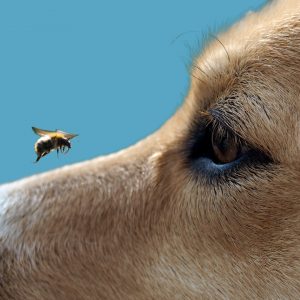 Bee on the nose of a dog
Definition
Insect sting
An insect sting is a local tissue reaction after the injection of venom or saliva, usually by a bee, wasp, or hornet. Typical symptoms are swelling, pain, and itching, sometimes also stronger allergic reactions. Stings in the mouth or throat area can lead to shortness of breath due to swelling.
Insect stings are a common problem in our pets, which in most cases are harmless, but can become life-threatening in certain situations. An insect sting is defined as the penetration of a stinger or mouthparts of an insect into the animal’s skin, often injecting toxins or irritating substances. In dogs and cats, stings from bees, wasps, hornets, and bumblebees, as well as bites from ants, mosquitoes, and horseflies, are particularly relevant. The reaction of the animal organism to these stings varies greatly and depends on various factors: the type of insect, the amount of venom injected, the location of the sting, and the individual sensitivity of the animal. While most stings only cause local reactions, some animals can develop allergic reactions that, in the worst case, can lead to anaphylactic shock. Stings in the area of the respiratory tract are particularly dangerous, as swelling can lead to life-threatening complications here.
Causes
Insect stings from bees, wasps, hornets, or ant bites, etc., in the area of the skin are usually harmless and do not require treatment (Fig.).
The symptoms that occur, such as itching and swelling, subside on their own.
In rare cases, an allergic reaction can occur (see – > anaphylaxis) and have dramatic consequences.
A sting in the throat area can also require treatment due to the resulting swelling.
Supplement
The causes of insect stings in pets are varied and depend heavily on the animals’ behavior and the environmental conditions. Insect stings are particularly common in the warm season when insects are more active. The different types of insects cause different reactions:
Bee stings are characterized by leaving the stinger behind with an attached venom sac. The venom contains enzymes, peptides, and biogenic amines that cause pain and inflammatory reactions. Bees usually only sting in defense.
Wasp stings can occur multiple times because wasps do not lose their stinger. Their venom contains similar components to bee venom, but in a different composition. Wasps are particularly attracted to sweets and meat and can react more aggressively than bees.
Hornet stings contain a higher concentration of venom and can therefore cause stronger reactions. However, hornets are less aggressive than often thought and usually only sting when directly threatened.
Mosquito bites lead to local reactions through saliva release and can, in rare cases, transmit pathogens. Mosquitoes are particularly active near water and at dusk.
Tick bites are a special case because they adhere for longer and can transmit various pathogens such as Borrelia or Anaplasma in addition to local reactions.
The curious behavior of many dogs and cats, especially sniffing and chasing insects, significantly increases the risk of stings in the face and mouth area.
Symptoms
Insect sting in dogs and cats
Typical Symptoms:
- Local swelling, redness, pain, itching
- Licking/Scratching, Wheal formation
- If stung in the mouth: increased salivation
Alarm signs:
- Swelling on head/neck/throat area, respiratory sounds, Respiratory distress
- Vomiting, Diarrhea,
- Weakness, increased heart rate, collapse (anaphylaxis)
- Multiple stings (e.g. swarm) + fatigue/increased temperature
Escalation/course:
- Minutes–1 h: Progression to anaphylaxis possible
- 6–24 h: Increasing swelling/pain, secondary infection possible
- Sting in the mouth/throat → Swelling can escalate with delay
The symptoms after an insect sting vary depending on the type of insect, the location of the sting, and the individual reaction of the animal. Stings in the respiratory tract and mouth require significantly more care.
Typical local reactions include redness, swelling, warmth, and tenderness at the injection site. These symptoms usually develop within a few minutes after the sting and can last for a few hours to days. Affected animals often lick or scratch at the sting site, which can lead to secondary infections.
Stings in the head and neck area are particularly dangerous. Swelling can quickly lead to respiratory distress here. Stings in the mouth or throat area can lead to life-threatening swelling that blocks the airways. Symptoms such as drooling, gagging, coughing, or shortness of breath are warning signs and require immediate veterinary assistance.
In case of allergic reactions, systemic symptoms can occur that affect the whole body. These typically develop within 20 minutes after the sting and include:
- Large-scale swelling that extends beyond the sting site
- Urticaria (hives) with wheal formation
- Vomiting and diarrhea
- Restlessness or lethargy
- Increased heart rate and respiratory rate
- Pale mucous membranes
- Collapse or unconsciousness
An anaphylactic shock is the most severe form of allergic reaction and can be fatal without rapid treatment. Animals with a known insect venom allergy have an increased risk of severe reactions to repeated stings.
Special considerations for cats
In cats, respiratory symptoms can become dominant more quickly. With mouth breathing, it’s an immediate red alert.
First Aid
- Removing the stinger and light cooling of the affected skin area are usually sufficient.
- Observe your animal a little in the next 30 minutes.
- Prevent your animal from scratching intensely, which can lead to a wound and subsequent infection.
When should you see a vet sooner?
Urgency from Orange to → Red with facial Swelling, Vomiting, shortness of breath, weakness, or collapse (Cause: Anaphylaxis).
Diagnosis
The diagnosis of an insect sting is primarily based on the clinical examination and the medical history. Pet owners often report an observed contact of their animal with insects or notice typical behavioral changes such as sudden howling, yelping, or hectic licking of a certain part of the body. During the clinical examination, the veterinarian looks for characteristic signs such as local swelling, redness, or a visible stinger.
In bee stings, the remaining stinger with attached venom sac can often be identified. This should be carefully removed, ideally by sideways scraping with a credit card or similar flat object to avoid further squeezing of the venom sac.
The differential diagnosis includes other causes of acute swelling and allergic reactions such as contact allergies, foreign bodies, bite injuries, or reactions to medications. In unclear cases or in the case of severe systemic reactions, further diagnostic measures may be necessary:
- Blood tests to assess inflammation parameters
- Allergy diagnostics using serological tests (IgE determination)
- In case of suspected secondary infections: bacteriological examinations
- In case of shortness of breath: X-rays of the thorax / chest to assess the airways
In animals with recurrent allergic reactions, an allergological evaluation may be useful to detect specific sensitizations and, if necessary, to initiate desensitization therapy.
Further veterinary measures
Further measures include removing the bee stinger with the venom reservoir, if this has not already happened.
If the stings with the subsequent swelling are found in regions where they can hinder breathing, agents against swelling should be given.
The veterinarian is familiar with the classification of the severity of an allergic (anaphylactic) reaction and will initiate appropriate measures accordingly (→ Allergic reaction (anaphylaxis)).
Supplement
The therapy for insect stings depends on the severity of the symptoms and ranges from simple first aid measures to intensive care. In the case of uncomplicated local reactions, specific treatment is often not necessary. The following therapeutic measures are used depending on the severity:
In the case of bee stings, the stinger should first be carefully removed, ideally by pushing it off sideways to avoid further squeezing of the venom sac. The sting site can then be cooled to reduce swelling and pain. Cool compresses should be applied for 10–15 minutes and repeated if necessary.
In the case of moderate local reactions, antihistamines can be used to reduce itching and swelling. Commonly used active ingredients are diphenhydramine, cetirizine, or chlorpheniramine in a veterinarian-adjusted dosage. However, these should only be administered after consulting with the veterinarian.
In the case of stronger inflammatory reactions, corticosteroids such as prednisolone or dexamethasone can be used. These have a strong anti-inflammatory effect and can be life-saving in the case of allergic reactions. The dosage and duration of use are determined individually by the veterinarian.
Emergency therapy is required for severe allergic reactions or anaphylactic shock:
- Epinephrine (Adrenalin) to stabilize the circulation and reduce bronchial constriction
- Intravenous fluid therapy for circulatory stabilization
- High-dose corticosteroids
- Oxygen administration for respiratory distress
- Intubation and ventilation in the case of severe airway obstruction
In the case of stings in the mouth or throat area with swelling that can impair the airways, immediate veterinary treatment is essential. In some cases, a temporary tracheotomy may be necessary to ensure breathing.
In the case of secondary infections of the sting site, antibiotic therapy may be necessary. The choice of antibiotic is ideally made after an antibiogram.
Prognosis and aftercare
The prognosis for insect stings is excellent in most cases. Local reactions usually subside within 24–48 hours without permanent damage. No special aftercare is required for uncomplicated stings, except for observing the sting site for signs of a secondary infection.
In animals that have shown an allergic reaction, the prognosis depends on the severity of the reaction and the speed of treatment. An anaphylactic shock treated in time has a good prognosis, while delayed treatment can lead to permanent organ damage or death. Animals with a known insect venom allergy should be monitored particularly closely, and pet owners should pay attention to potential insect contacts.
Aftercare for severe reactions includes close monitoring of the animal for signs of renewed deterioration. After anaphylaxis, the animal is often monitored in the hospital for 24–48 hours, as biphasic reactions can occur in which symptoms reappear after an apparent improvement.
For animals with a known insect venom allergy, the veterinarian can prescribe an emergency kit with antihistamines and, if necessary, an epinephrine auto-injector and train the owner in its use. In addition, desensitization therapy (specific immunotherapy) can be considered to reduce the allergic reaction in the long term.
For the future, it is important to take preventive measures to avoid further stings. These include avoiding areas with high insect activity, especially in the summer months, and using animal-friendly insect repellents after consulting with the veterinarian.
Summary
Insect stings in dogs and cats are common occurrences that in most cases are associated with mild local reactions and do not require specific treatment. The symptomatology ranges from local swelling and redness to life-threatening allergic reactions. Stings in the area of the respiratory tract are particularly dangerous, as swelling can lead to respiratory distress.
First aid measures include carefully removing bee stingers, cooling the sting site, and observing the animal for signs of an allergic reaction. In the case of severe reactions, immediate veterinary treatment is essential, which may include antihistamines, corticosteroids, and epinephrine in the case of anaphylactic shock.
The prognosis is good with timely treatment, but animals with a known insect venom allergy should be particularly protected. Preventive measures such as avoiding areas with high insect activity and using suitable repellents can reduce the risk of future stings.
Pet owners should know the symptoms of an allergic reaction and when veterinary help is needed. With the right knowledge and quick action, even severe reactions to insect stings can be successfully treated.
Outlook on current research
Research in the field of insect venom allergies in pets continues to evolve. Current studies focus on improved diagnostic methods that allow for more precise identification of the triggering insect venoms. Molecular allergy tests that can detect specific components of insect venoms are increasingly being used in veterinary medicine and allow for a more accurate differentiation between cross-reactions and true sensitizations.
In the field of therapy, new protocols for desensitization (specific immunotherapy) are being researched, which should enable a more effective and faster hyposensitization. These could improve the treatment options for animals with severe insect venom allergies in the future.
Innovative emergency medications with a prolonged duration of action and improved stability are being developed to optimize the initial care of allergic reactions. Furthermore, researchers are working on more animal-friendly formulations of antihistamines and corticosteroids with a reduced side effect profile.
Another research focus is on the development of more effective and simultaneously environmentally friendly insect repellents for pets. Natural active ingredients are being investigated for their efficacy and tolerability to find chemical alternatives with lower environmental impact.
Climate change is leading to altered distribution areas of various insect species, which brings new challenges for veterinary medicine. Studies on the spread of new insect species and their potential impacts on pet health are gaining increasing importance.
Frequently asked questions (FAQs)
- How do I know if my animal has been stung by a bee or wasp?
In the case of bee stings, the stinger with the venom sac often remains stuck in the skin, while wasps keep their stinger and can sting multiple times. Bee stings are often more painful, while wasp stings tend to burn more. - Can I give my animal human antihistamines?
Some antihistamines approved for humans can also be used in animals, but only after consulting with the veterinarian and in the correct, species-specific dosage. Some human preparations contain additives that can be toxic to animals. - How do I remove a bee stinger correctly?
The stinger should be carefully scraped off sideways with a credit card or a similar flat object. Pulling it out with your fingers or tweezers can lead to squeezing of the venom sac and should be avoided. - When do I need to take my animal to the vet if it has been stung?
Immediate veterinary assistance is required for stings in the mouth or throat area, respiratory distress, severe swelling, vomiting, diarrhea, weakness, collapse, or known insect venom allergy. - Can my animal develop an allergy to insect stings?
Yes, dogs and cats can develop allergies to insect venoms. An allergic reaction can occur with the first sting or only after several stings and can become more severe with each further contact. - How can I protect my animal from insect stings?
Avoid walks in areas with high insect activity, especially in the morning and evening hours. Keep your distance from flowers, garbage cans, and fallen fruit. After consulting with the veterinarian, special repellents for animals can be used. - Can insect stings leave scars on my animal?
In most cases, insect stings heal without scar tissue formation. However, severe scratching or licking can lead to secondary infections that can lead to scar tissue formation. - Is a hornet sting more dangerous for my animal than a bee sting?
Hornet venom contains a higher concentration of toxins, which can lead to stronger local reactions. However, the danger mainly depends on the individual sensitivity of the animal. - How long does it take for the swelling to subside after an insect sting?
In the case of uncomplicated stings, the swelling largely subsides within 24–48 hours. It may take longer for larger swellings or allergic reactions. - Can my animal die from a single insect sting?
A single insect sting can be fatal in the case of a severe allergic reaction (anaphylactic shock) if no timely treatment is given. In non-allergic animals, individual stings are usually not life-threatening, unless they occur in the area of the respiratory tract and lead to its obstruction.
Literature
- Kohn, B. u. G. Schwarz: Praktikum der Hundeklinik, Enke, 12th edition, Stuttgart 2017
- Sigrist, N. (Ed.): Notfallmedizin für Hund und Katze; Sofortmaßnahmen und sichere Aufarbeitung. Stuttgart, Enke Verlag 2017.
- Löwe, G. and Löwe, O. (2021). Emergencies in Dogs and Cats – A Veterinary Guide. Kynos-Verlag. 208 p.
- Mueller RS, Jensen-Jarolim E, Roth-Walter F, Marti E, Janda J, Seida AA, DeBoer D. Allergen immunotherapy in people and dogs with allergies: a comparative review. Journal of Allergy and Clinical Immunology: In Practice. 2018;6(4):1363-1376.
- Saridomichelakis MN, Olivry T. An update on the treatment of canine atopic dermatitis. The Veterinary Journal. 2016;207:29-37.
- Rudloff E, Kirby R. Anaphylaxis and angioedema. In: Silverstein DC, Hopper K, editors. Small Animal Critical Care Medicine. 2nd ed. St. Louis: Elsevier; 2020. p. 807-812.