
Home » Diseases » Emergencies / First Aid for Dogs & Cats – General Information » Emergencies / First Aid A-Z » Foreign body in the ear canal
Foreign body in the ear canal
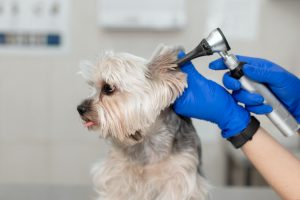 Examining the ear with an otoscope on a dog in a veterinary practice
 The seed heads of wild oats are common foreign bodies in the external ear canal of the dog.
You might also be interested in: Foreign bodies in dogs and cats
Definition
Foreign body in the ear canal
A foreign body in the ear is usually an awn, a part of a plant or an insect that is stuck in the ear canal. Typical symptoms are sudden head shaking, painful scratching and one-sided “tilting” of the head. Migration or injury can lead to inflammation and eardrum damage.
Foreign bodies in the ear canal are foreign objects that enter and remain in the external ear canal of dogs or cats. The ear canal of our pets consists of a vertical and a horizontal part, which together form an L-shaped canal that leads to the eardrum. This anatomical feature makes it difficult to spontaneously shake out foreign bodies. The ear canal is lined with skin and contains glands that produce earwax, which normally transports dirt and foreign bodies to the outside. In dogs, the ear canal is significantly longer than in cats, which leads to an increased susceptibility to foreign body inclusions, especially in breeds with drooping ears. Understanding these anatomical basics is helpful for the prevention and therapy of foreign bodies in the ear of our pets.
Causes
The causes of foreign bodies in the ear canal are varied and depend on the season and the animal’s living environment. In the summer months, plant-based foreign bodies are particularly common. Awns from grasses and cereals, especially wild oats, pose a particular problem due to their arrow-like structure with barbs. These can only move in one direction – deeper into the ear canal – causing considerable irritation and injury. In addition to plant materials, insects such as ticks, fleas or flies can also get into the ear canal and act as foreign bodies there. In cats that are often in dusty environments such as attics, dust particles and small dirt particles can lead to problems. In dogs that like to swim, sand or dirt can get into the ear canal and remain there. Iatrogenic foreign bodies should not be underestimated – i.e. those caused by human actions, such as broken cotton swab tips during improper ear cleaning. In long-haired breeds, hairs can also grow into the ear canal and act as foreign bodies or hold other foreign bodies in place.
Symptoms
Foreign body in the ear canal in dogs and cats
Typical Symptoms:
- Head shaking, scratching the ear, head tilted to one side
- Sudden pain when touching the ear
- Often acute onset after a walk (awns)
Alarm signs:
- Severe pain reaction, screaming, violent head shaking
- Bleeding or strong foul-smelling discharge
- Neurological signs: head tilted + balance disorders (rare, but critical)
- Suspected eardrum injury (pain + heavy discharge)
Escalation/course:
- Foreign body can increase inflammation/trauma within hours
- Increasing discharge/pain after 24–48 h → otitis/tissue damage
- Longer course → risk of deep migration (especially awns) and chronification
Foreign objects in the ear canal can lead to itching, pain, inflammatory conditions, and prolonged infections. The symptoms of a foreign object in the ear canal are often clearly recognizable and should be taken seriously by pet owners. Affected animals often show noticeable head shaking, which can appear suddenly and is particularly intense after spending time outdoors. This shaking is an attempt by the animal to dislodge the irritating foreign object. At the same time, animals scratch the affected ear more frequently, which can lead to skin abrasions or even an aural hematoma. Another characteristic symptom is head tilted to one side towards the affected side, as this reduces the sensation of pain. Upon closer inspection, pet owners can often observe redness of the ear flap and the visible part of the ear canal. In advanced cases, a foul-smelling discharge from the ear may occur, indicating a secondary bacterial infection. Some animals also show behavioral changes such as increased irritability or lethargy due to the pain. In cases where foreign objects are deep in the ear canal or touch the eardrum, neurological symptoms such as balance disorders or uncoordinated movements may occur. In particularly severe cases, hearing loss can occur, which is noticeable through a reduced reaction to acoustic stimuli.
Special considerations for cats
Ear mites/Inflammatory conditions are common in cats. Foreign bodies are less common.
First Aid
- When you see ripe wild oat spikes along the roadside in summer, check your pet’s entire body, paws, and ears (both on and inside) after every walk to see if any seed heads have gotten stuck in the fur. Remove them if possible.
- However, do not use cotton swabs to clean the ear canal. You could push the foreign body deeper into the ear canal.
- You should only use tweezers if you are experienced and the foreign body is easy to see.
- You can try to flush out other foreign bodies with lukewarm water. You can use a small rubber ball ear syringe or a simple syringe to push water into the ear canal with some pressure and flush out a non-stuck foreign body.
When should you see a vet sooner?
Urgency changes from yellow to → orange in cases of severe pain, balance disorders, bleeding, or neurological signs.
If you are not successful, take your animal to a veterinarian for a more detailed examination of the ear canal.
Diagnosis
The diagnosis of a foreign body in the ear canal requires a thorough veterinary examination. First, a medical history is taken, in which I, as a veterinarian, ask about the onset of symptoms, possible triggering events and previous ear problems. The clinical examination begins with a visual inspection of the auricle and the external ear canal. The decisive diagnostic step is otoscopy, in which the entire ear canal up to the eardrum is examined with a special instrument, the otoscope. This examination enables direct visualization of the foreign body as well as the assessment of inflammatory conditions, swelling or injuries to the ear canal wall. In nervous or pain-sensitive animals, sedation or even short-term anesthesia may be necessary to carry out a thorough examination without causing the animal additional pain or risking further injury. In some cases, the view is restricted by secretions or inflammatory products, so careful rinsing of the ear canal may be necessary first. In addition to otoscopy, a smear is often taken for a cytological examination and, if necessary, a microbiological culture to identify and specifically treat secondary infections. If deeper damage is suspected, especially if the eardrum cannot be seen or middle ear involvement is suspected, imaging procedures such as X-ray or, better still, computed tomography may be necessary.
Further veterinary measures
The therapy for foreign bodies in the ear canal is primarily aimed at gently removing the foreign material. Depending on the location, type of foreign body and the animal’s willingness to cooperate, I, as a veterinarian, choose different approaches. In the case of superficially visible, loose foreign bodies, careful extraction can be carried out with fine tweezers or special ear forceps under visual control. Deeper or firmly adhering foreign bodies usually require sedation or short anesthesia to avoid pain and enable precise removal. In the case of plant-based foreign bodies such as awns that have already burrowed into the ear canal wall, special care must be taken to avoid leaving any fragments behind. After removing the foreign body, the ear canal is thoroughly rinsed with body-warm physiological saline solution or special ear cleaning solutions to remove any remaining residue. The ear canal is then carefully examined for injuries and the condition of the eardrum. In the case of accompanying otitis externa (inflammation of the ear canal) or secondary bacterial infections, I prescribe topical medications that contain anti-inflammatory and antimicrobial agents. These must mostly be used over 7–14 days. In the case of injuries to the eardrum or involvement of the middle ear, systemic antibiotics and pain relievers are indicated. Close follow-up is important to monitor the healing process and adjust the therapy if necessary. In particularly severe cases with chronic changes or repeated foreign body episodes, surgical measures such as ear canal ablation (partial removal of the ear canal) may be considered.
Prognosis and aftercare
The prognosis for foreign bodies in the ear canal is good in most cases, provided that they are removed promptly and professionally. The healing process depends on how long the foreign body has been in the ear and what damage it has caused. With early treatment without complications, complete recovery is expected within 7–14 days. Aftercare plays an essential role in the success of the therapy. As a veterinarian, I recommend regular check-ups, initially after about a week, to monitor the healing process and ensure that no remnants of the foreign body remain. The correct application of prescribed medications is essential – ear drops or ointments must be applied after a thorough but gentle cleaning of the external ear canal. The owner should make sure that the animal does not shake its head immediately after the treatment. A neck brace may be necessary in some cases to prevent the animal from scratching the ear and disrupting the healing process. In animals with drooping ears, carefully tying up the ears can improve ventilation and promote healing. In the long term, prevention of further foreign body episodes is important. This includes regular ear inspections, especially after stays in tall grass or on grain fields, as well as appropriate ear hygiene. In dogs with predisposing factors such as excessive hair in the ear canal, regular plucking of the hairs by a veterinarian or a trained caregiver can be useful.
Summary
Foreign bodies in the ear canal are a common problem in dogs and cats that requires quick action. The anatomical structure of the ear canal with its L-shaped course favors the retention of foreign material. Plant-based foreign bodies such as awns with their barbs can cause considerable damage if they are not removed promptly. The affected animals show typical symptoms such as intense head shaking, scratching at the ear and head tilted to one side. A thorough veterinary examination using otoscopy is essential for diagnosis. The therapy consists of the gentle removal of the foreign body, often under sedation or anesthesia, followed by appropriate drug therapy for accompanying inflammatory conditions or infections. The prognosis is good with early intervention, with aftercare including regular check-ups and correct medication ensuring the success of the therapy. Preventive measures such as regular ear inspections after stays outdoors and appropriate ear hygiene can reduce the risk of renewed foreign body episodes. Special attention should be paid to breeds with drooping ears or excessive hair in the ear canal, as these have an increased risk. By educating pet owners about the importance of early veterinary attention if a foreign body in the ear is suspected, complications can be avoided and the quality of life of our animal companions can be maintained.
Outlook on current research
Research in the field of ear diseases in small animals is constantly evolving, which also brings new findings and therapy approaches for foreign bodies in the ear canal. Current studies are concerned with improving diagnostic procedures, in particular video otoscopy with high-resolution cameras, which enable a more detailed visualization of the ear canal and facilitate documentation for follow-up checks. A promising area of research is the development of special instruments for the minimally invasive removal of foreign bodies, which can also be used in awake animals and minimize the risk of injury. Scientists are also investigating new topical formulations with improved antimicrobial and anti-inflammatory properties that are intended to promote faster healing after foreign body removal. Particular attention is paid to active ingredients that are also effective against biofilm-forming bacteria, which often play a role in chronic ear infections. Another research focus concerns the genetic factors that lead to an increased susceptibility to ear problems in certain dog breeds. These findings could be incorporated into breeding programs in the long term to reduce the prevalence. The connections between allergies, environmental factors, and susceptibility to foreign bodies in the ear canal are also being researched more intensively to optimize preventative strategies. The development of protective devices for dogs working in vulnerable environments, such as tall grass, is another practical field of research. These innovations promise to make the diagnosis and treatment of foreign bodies in the ear canal even more effective and gentle in the future.
Frequently asked questions (FAQs)
- Which dog breeds are particularly susceptible to foreign bodies in the ear canal?
Breeds with drooping ears such as Cocker Spaniels, Basset Hounds or Beagles are particularly at risk because the ventilation of the ear canal is restricted. Long-haired breeds such as Shih Tzu or Yorkshire Terriers are also particularly at risk, as hair can also grow into the ear canal. - Can I remove a foreign body from my animal’s ear myself?
I strongly advise against attempting self-treatment, especially for deeper foreign bodies. Improper manipulations can lead to injuries to the ear canal or eardrum and worsen the situation. - How can I tell if my animal has a foreign body in its ear?
Typical signs are sudden, intense head shaking, increased scratching at the ear, head tilted to one side, reddening of the auricle and occasionally a foul-smelling discharge from the ear canal. - How long does healing take after removing a foreign body from the ear?
In uncomplicated cases and early treatment, complete healing is expected within 1–2 weeks. In the case of complications such as deeper infections or injuries to the eardrum, the healing process can take several weeks. - What preventive measures can I take to avoid foreign bodies in my animal’s ear?
Check your animal’s ears regularly, especially after walks in tall grass or on grain fields. In long-haired breeds, regularly shortening the hair around the ear opening can be helpful. Avoid improper ear cleaning with cotton swabs. - Can a foreign body in the ear lead to permanent hearing damage?
Yes, if a foreign body is left untreated for a long time or the eardrum is injured, this can lead to permanent hearing damage. Plant-based foreign bodies in particular can damage deeper structures of the ear as they migrate. - How often should I clean my dog’s ears?
The frequency of ear cleaning depends on the individual tendency to ear problems. For healthy ears without excessive earwax production, cleaning every 2–4 weeks is sufficient. Dogs with recurring ear problems may need more frequent cleaning as directed by a veterinarian. - What are the differences in foreign bodies in the ear between dogs and cats?
Cats are generally less affected by foreign bodies in the ear canal than dogs because they are more selective in their choice of environment and groom their fur more intensively. In addition, their ear canal is anatomically designed differently. Ear mites are more common in cats as a cause of ear problems. - Can a chronic ear infection be related to an overlooked foreign body?
An unrecognized foreign body is a common cause of therapy-resistant, chronic ear infections. A thorough otoscopic examination should always be carried out in the event of recurring or therapy-resistant ear problems. - Are certain seasons particularly risky for foreign bodies in the ear?
Yes, especially in late spring and summer, when grasses and cereals form their seeds, the risk of plant-based foreign bodies such as awns increases. During this time, pet owners should be particularly attentive and check their animals’ ears regularly.
Literature
- Kessler, B. W. (n.d.). Ear Canal Obstruction. In MSD Manual – Professional Edition. Retrieved August 12, 2025, from https://www.msdmanuals.com/de-de/profi/hals-nasen-ohren-krankheiten/aussenohrerkrankungen/gehörgangsobstruktion
- Löwe, G., & Löwe, O. (2021). Notfälle bei Hund und Katze – Ein tierärztlicher Ratgeber (208 S.). Kynos-Verlag.
- Paterson, S., & Tobias, K. (2020). Atlas of ear diseases of the dog and cat (2nd ed.). Wiley-Blackwell.
- Saridomichelakis, M. N., Farmaki, R., Leontides, L. S., & Koutinas, A. F. (2022). Aetiology of canine otitis externa: A retrospective study of 100 cases. Veterinary Dermatology, 33(1), e12–e19. https://doi.org/10.1111/vde.13035
- Tambella, A. M., Attili, A. R., Beribè, F., Rossi, G., Gavazza, A., & Laus, F. (2020). Management of otitis externa with an LED-illuminated otoscope and optical coherence tomography. Veterinary Sciences, 7(4), 134. https://doi.org/10.3390/vetsci7040134