
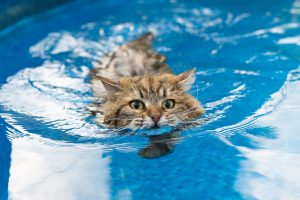
 Cat in the pool. There is a risk of drowning.
Near drowning is rare in dogs and cats but can be life-threatening. New devices that allow veterinarians to quickly take pictures of the heart and lungs directly in the practice or hospital, as well as modern “artificial lung or kidney replacement systems” (ECMO, CVVH), offer additional possibilities in the future, and experience from human medicine is also incorporated. This is the only way to improve the chances of survival and the quality of life of affected dogs and cats in the long term.
Drowning
Author: Dr. med. vet. Gisa Löwe | Last modified: 17.02.2026
Content
Download/Print
Definition
Drowning
Drowning is a life-threatening respiratory disorder after water has entered the airways (water aspiration). The result is impaired oxygen absorption in the lungs. Even after initial stabilization, pulmonary edema or aspiration pneumonia can develop with a delay. Every near-drowning case is an emergency requiring monitoring.
Near-drowning refers to a condition in which an animal suffers respiratory impairment due to submersion in liquid, but does not die immediately. During the drowning process, there is an interruption of normal breathing due to immersion of the airways in liquid. The pathomechanism is complex and differs depending on the type of liquid. In fresh water, hypotonic fluid enters the lungs and is rapidly absorbed into the blood, which can lead to hemolysis and electrolyte imbalances. In salt water, on the other hand, the hypertonic fluid draws plasma from the blood into the lungs, leading to pulmonary edema. Both processes significantly impair gas exchange and lead to Hypoxia.
The physiology of drowning follows a characteristic course: First, the airways close reflexively to prevent water from entering. This Laryngospasmus can last up to two minutes. Subsequently, the increasing CO₂ level in the blood leads to an involuntary breathing reflex, whereby water enters the lungs. The resulting Hypoxia leads to loss of consciousness and ultimately to circulatory arrest if no rescue measures are taken.
In dogs and cats, it is particularly important to note that life-threatening complications can still occur even after an apparent recovery, especially secondary drowning, in which pulmonary edema can develop hours after the incident.
Causes
All animals can swim. However, if they get into a body of water from which they cannot get out on their own, they are in danger of drowning due to exhaustion (Fig.).
The causes of near-drowning in pets are varied and strongly related to living conditions and access to water. Unsupervised access to pools, ponds or other open bodies of water is the most common cause. Animals with no experience with water are particularly at risk. Cats are more likely to get into emergency situations because they are naturally less fond of swimming than many dogs.
Certain risk groups are particularly at risk: brachycephalic (short-nosed) dog and cat breeds such as pugs, French bulldogs or Persian cats have an increased risk of breathing problems in the water due to their anatomy. Older animals with limited mobility or neurological diseases, as well as puppies and young animals without swimming experience, are also particularly at risk.
Environmental factors also play an important role. Strong currents in rivers, cold water that leads to rapid hypothermia, or ice cover on bodies of water in winter pose specific dangers. In addition, pre-existing health conditions such as epilepsy or heart disease can lead to sudden loss of consciousness in the water.
An often underestimated factor is exhaustion: even animals that are able to swim can drown if they cannot find a way out of the water or become exhausted due to panic. This occurs particularly in pools with steep walls without exit aids.
Symptoms
Drowning in dogs and cats
Typical Symptoms:
- Cough, Gagging, water from mouth/nose, Restlessness
- Rapid breathing, weakness, possibly Vomiting
- Hypothermia common
Alarm signs:
- Dyspnea, cyanosis, frothy discharge
- Impaired consciousness, collapse, Seizures
- Persistent Cough + increasing respiratory rate after the event
- Low temperature, shivering no longer possible (exhaustion)
Escalation/course:
- Secondary pulmonary edema/inflammation can develop within 1–24 h
- Symptoms may be mild at first and escalate later → close monitoring
- Increasing breathing effort in the hours after the incident → emergency
When going under, the airways initially close reflexively to prevent water from entering the lungs. If the animal remains under water for too long, this reflex disappears. This leads to swallowing larger amounts of liquid. Water enters the lungs due to a respiratory reflex that can no longer be suppressed. A Laryngospasmus initially prevents a lot of water from entering the lungs. If the spasm resolves, more fluid enters the lungs. Due to Laryngospasmus or increasing fluid in the lungs, gas exchange can no longer function properly. Loss of consciousness, Seizures, Cardiac arrhythmia, weak pulse and circulatory arrest are the consequences. Death occurs after 3 to 5 minutes.
Even if the animal appears to have recovered from the incident, serious consequences such as the development of pulmonary edema can occur afterwards.
The symptoms of near-drowning in dogs and cats can be divided into acute and delayed signs. Immediately after the incident, the following symptoms may occur: Cough and Gagging, rapid and labored breathing (Dyspnea), bluish or pale mucous membranes (cyanosis), loss of consciousness or severely reduced responsiveness, and Vomiting of water or stomach contents. In severe cases, Seizures, Cardiac arrhythmia and circulatory failure can occur.
Particularly insidious are the delayed symptoms, which can develop only hours after the incident. These include increasing Dyspnea, persistent Cough, lethargy and loss of appetite, increased body temperature, and rattling or gurgling breathing sounds. These signs may indicate secondary drowning, in which pulmonary edema develops after the animal has already been rescued and initially appeared stable.
The severity of the symptoms depends on various factors: the duration of submersion, the type of liquid (fresh or salt water), the water temperature and the general health of the animal. Especially in cold water, hypothermia can mask the symptoms and make diagnosis more difficult.
Pet owners should know that even animals that appear to have fully recovered after a water accident must be closely monitored, as life-threatening complications can still occur up to 24 hours after the incident.
Special considerations for cats
Even a small amount of water aspiration can be critical. Always take mouth breathing or an increased breathing rate (tachypnea) after water intake seriously.
First Aid
- Get your animal out of the water as quickly as possible, but protect yourself.
- Lay your animal on its side so that the head is the lowest point, so that any remaining water can drain well and stomach contents cannot get into the airways.
- Open the mouth and gently pull the tongue forward. If your animal is not too heavy, you can hold it head down. A gentle tapping massage on the thorax / chest by a second person promotes the drainage of fluid from the lungs.
- If your animal is not breathing, start resuscitation. Resuscitation for drowning begins with ventilation, not chest compressions as usual.
- Keep your animal warm with a blanket.
- If your dog has access to a swimming pool, teach him where there is a staircase or other possible exit for your dog.
When should you see a vet sooner?
Red always means an emergency. See a vet immediately. If the animal is unconscious, start resuscitation right away.
Diagnosis
The diagnosis of near-drowning begins with the medical history, in which the circumstances of the incident are asked in detail. Important information includes the approximate duration of submersion, the type of water (fresh or salt water), the water temperature and the time since the incident. In the clinical examination, the veterinarian pays particular attention to vital parameters such as breathing, heart rate, mucous membrane color and body temperature.
The auscultation of the lung is crucial to identify crackles, crackling sounds or weakened lung areas that may indicate pulmonary edema or aspiration. Pulse oximetry to measure oxygen saturation in the blood provides information about the severity of respiratory impairment.
Imaging procedures play a central role in the diagnosis. X-rays of the thorax / chest can detect fluid accumulations in the lungs, pulmonary edema or aspiration pneumonia. In the case of unclear findings, an ultrasound examination of the lung can be used in addition to identify pleural effusions or consolidated lung areas.
Laboratory tests include a complete blood count to assess inflammatory reactions, blood gas analyses to assess the acid-base balance and oxygenation, and electrolyte determinations, as electrolyte imbalances can occur especially with fresh water aspiration. If a bacterial secondary infection is suspected, a culture of the tracheal secretions may be useful.
Even in animals that initially show no obvious symptoms, a thorough diagnosis is important, as complications such as secondary drowning can still develop hours after the incident.
Further veterinary measures
Even if your animal seems to be recovering, see a veterinarian.
The veterinarian’s treatment will also focus on treating cardiac and respiratory arrest, the resulting lack of oxygen with its consequences for the brain, heart and other organs, and treating any hypothermia.
Inpatient treatment is advisable until all changes in the organism have been compensated for.
Even patients with mild symptoms, radiologically unremarkable lungs and good oxygen saturation in the blood should be monitored as inpatients for at least a few hours.
Veterinary treatment includes several components: Oxygen therapy is essential and can be administered via oxygen cages, nasal probes or, in severe cases, by intubation and mechanical ventilation. Fluid therapy is used to compensate for electrolyte imbalances and stabilize the circulation, whereby the type and amount of infusions must be individually adjusted.
In the development of pulmonary edema, Diuretika such as furosemide are used to remove excess fluid from the lungs. Bronchodilators can help to dilate the airways in the event of bronchospasm. If a bacterial secondary infection is suspected, antibiotic therapy is indicated. Analgesics and sedatives can be used for pain relief and sedation.
Heat therapy is particularly important for animals that have had an accident in cold water in order to treat or prevent hypothermia. In severe cases, intensive care monitoring with continuous monitoring of vital parameters may be necessary for several days.
Prognosis and aftercare
The prognosis after near-drowning depends largely on the duration of Hypoxia, the speed of initial care and the extent of lung damage. Animals that were under water for less than five minutes and were rescued quickly generally have a better prognosis than those with a longer duration under water (submersion time). Another crucial factor is the water temperature: Paradoxically, very cold water can offer a certain protective effect through the diving reflex and the slowing down of metabolism and improve the chances of survival.
Aftercare includes close monitoring for at least 24–48 hours after the incident, as secondary drowning can still develop with a delay. Monitoring parameters include respiratory rate and pattern, heart rate, body temperature, activity level and appetite. Regular veterinary check-ups with X-rays of the lungs are recommended to detect the regression of pulmonary edema or the development of pneumonia at an early stage.
In animals with neurological damage due to Hypoxia, a rehabilitation phase with physiotherapeutic measures may be necessary. The duration of complete recovery varies greatly and can range from a few days to several weeks.
It is important for pet owners to understand that late sequelae, including chronic lung problems or subtle neurological deficits, can occur even after an apparent complete recovery. Therefore, even animals that have survived the incident well should be carefully observed in the following weeks.
The prevention of drowning accidents in pets is based on several safety measures. Pools should be secured with covers or fences that are insurmountable for animals. For garden ponds, shallow entry areas or special animal exit aids are recommended. When boating with dogs, life jackets for animals should always be used, which are adapted to the body weight and size of the animal.
Swimming training for dogs is an important preventive measure. The animal should be slowly and positively accustomed to the water. It is particularly important to teach the dog how to get out of a pool or body of water. For cats, which are generally less fond of swimming, securing water areas is mainly crucial.
Special caution is required for risk groups: Brachycephalic breeds, older animals, puppies and animals with health restrictions should never be left unattended near water. In the cold season, special caution is required with frozen bodies of water, as animals cannot assess the load-bearing capacity of the ice.
It is also advisable for pet owners to complete a first aid course for animals in order to be able to react correctly in an emergency. A well-equipped first aid kit should always be available near water.
Summary
Near drowning is a life-threatening emergency for dogs and cats, requiring quick and knowledgeable action. The drowning process begins with a reflexive closure of the airways, followed by involuntary inhalation of water, which can lead to severe hypoxia. Secondary drowning is particularly insidious, as pulmonary edema can develop hours after the incident.
Initial care includes securing the airways, providing ventilation and chest compressions if necessary, and seeking veterinary attention as quickly as possible. Veterinary treatment focuses on oxygen therapy, fluid management, and the treatment of complications such as pulmonary edema or secondary infections.
The prognosis depends largely on the duration of hypoxia and the speed of initial care. Preventive measures such as securing water areas, swimming training for dogs, and special caution for at-risk groups can prevent drowning accidents.
It is important for pet owners to understand that even animals that appear to have fully recovered after a water accident must be closely monitored for at least 24–48 hours, as life-threatening complications can occur with a delay.
Outlook on current research
Frequently asked questions (FAQs)
- Can all dogs swim naturally?
Although many dogs can paddle instinctively, this does not mean that all dogs can swim effectively. Short-nosed breeds, heavy dog breeds or animals with anatomical peculiarities in particular may have difficulties and tire quickly. - How long can an animal survive under water?
Survival time under water varies greatly, but is typically 3–5 minutes before irreversible brain damage occurs. In very cold water, this time may be extended by the diving reflex. - What is secondary drowning and how do I recognize it?
In secondary drowning, pulmonary edema develops hours after the water accident. Signs include increasing Dyspnea, Cough, lethargy and rattling breathing sounds. - Should I always see a veterinarian after a near-drowning, even if my animal recovers quickly?
Yes, definitely. Even with seemingly complete recovery, delayed complications such as secondary drowning can develop, which can be life-threatening. - Is there a difference between drowning in fresh and salt water?
Yes, the physiological effects differ. Fresh water is rapidly absorbed into the blood and can lead to hemolysis and electrolyte imbalances. Salt water draws fluid from the blood into the lungs and causes pulmonary edema more quickly. - How can I teach my dog to safely exit a pool?
Practice using the stairs or exit aid with your dog in calm weather. Lead him in and out several times until he finds his way independently. Reinforce the behavior positively with rewards. - Are certain dog or cat breeds particularly at risk?
Yes, brachycephalic (short-nosed) breeds such as pugs, bulldogs or Persian cats have an increased risk due to their airway anatomy. Very heavy or older animals with limited mobility are also at risk. - How long should I observe my animal after a near-drowning?
At least 24–48 hours, as complications such as secondary pulmonary edema can still develop with a delay.
Yes, definitely. Even with seemingly complete recovery, delayed complications such as secondary drowning can develop, which can be life-threatening.
Literature
- Acute care for drowning accidents. Thieme – via medici – inform. Copyright 2019 Georg Thieme Verlagsgruppe
- https://www.thieme.de/viamedici/klinik-faecher-notfallmedizin-1539/a/ertrinken-3947.htm
- Löwe, G. and Löwe, O. (2021). Emergencies in dogs and cats – A veterinary Guide. Kynos-Verlag. 208 pp.
- Drobatz, K.J., Hopper, K., Rozanski, E., Silverstein, D.C. (2018). Textbook of Small Animal Emergency Medicine. Wiley-Blackwell, Hoboken, NJ. P. 325-331.
- Schaer, M., Gaschen, F. (2020). Clinical Medicine of the Dog and Cat. 4th edition. CRC Press, Boca Raton. P. 412-418.
- Mathews, K.A., Dumars, S.A., Ogeer-Gyles, J.S. (2021). “Near drowning in companion animals: pathophysiology and management.” Journal of Veterinary Emergency and Critical Care, 31(2), 141-152.
- Plunkett, S.J. (2022). Emergency Procedures for the Small Animal Veterinarian. 4th edition. Elsevier, Amsterdam. P. 178-186.
- Rozanski, E.A., Chan, D.L. (2019). Small Animal Critical Care Medicine. 3rd Edition. Elsevier, St. Louis. P. 267-273.