


Home » PetsVetCheck for veterinary hospitals and small animal practices
PetsVetCheck for
veterinary hospitals and small animal practices
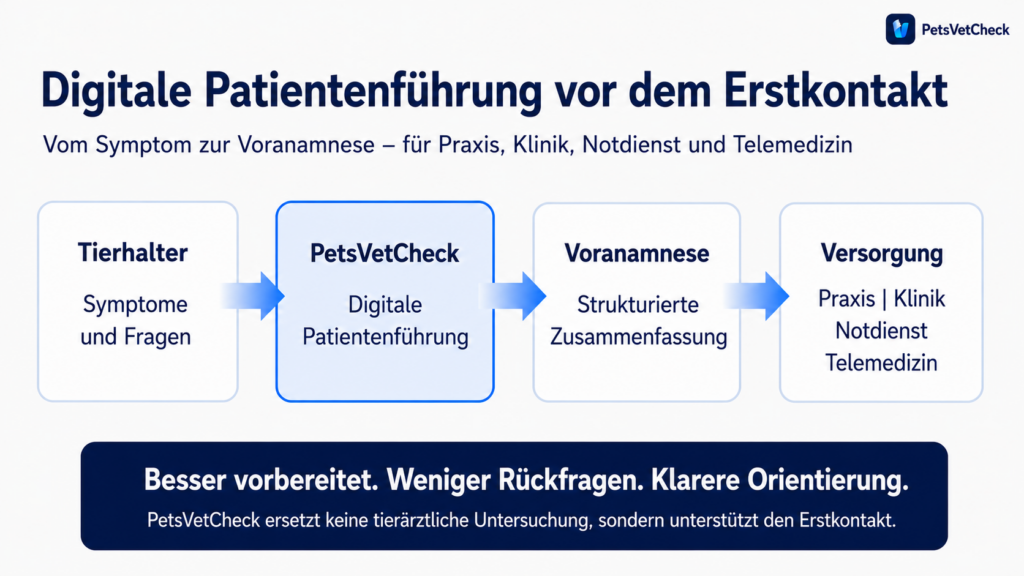
Digital patient management for initial contact, pre-medical history, and daily practice routine
PetsVetCheck offers:
- Better prepared pet owners
- Triage and structured pre-anamnesis
- Relief for teams
PetsVetCheck is suitable for:
- Small animal hospitals, hospital groups, small animal practices
- Emergency services, telemedical services
- Mobile veterinary practices
Why digital patient management is becoming important right now
Today, pet owners often inform themselves before their first contact with a practice or hospital. At the same time, the demands for communication, accessibility, and service are steadily increasing.
Many inquiries begin with non-specific symptoms, while time and personnel resources are limited. Therefore, the structured recording and sharing of relevant information even before the initial contact is becoming increasingly important.
What PetsVetCheck can already do today
- Structured digital pre-medical history
- Triage (Emergency, Urgent, Prompt, Monitor)
- Digital transmission of the conversation history to the practice or hospital
- Veterinary information on symptoms, diseases, emergencies, and poisonings
Benefits for practice and hospital
1
Relief for the team
- Fewer unstructured inquiries
- Fewer unnecessary emergency service contacts
- Less repetitive basic education
2
Faster medical history and admission
- Relevant information is available earlier
- Shorter medical history times
- Structured handover
3
Better patient steering
- Support in classifying emergencies
- Appropriate assignment to care pathways (emergency service, scheduled consultation, telemedicine)
- Clearer orientation for pet owners
4
Support for the team
- Standardized processes
- Knowledge becomes available independently of specific individuals
- Relief even with increasing patient volume
Clinically oriented knowledge base
PetsVetCheck is based on a comprehensive veterinary knowledge base for dogs and cats. The AI-powered assistant does not work on general internet content, but on a curated knowledge structure with evidence-oriented sources, defined safety mechanisms, and veterinarilly developed decision paths.
- Extensive knowledge base
- Symptom-oriented pre-medical history
- Emergency detection
- Safety and escalation rules
- Veterinarilly developed
- Veterinary content for dogs and cats as the basis for patient management.
- Structured recording of relevant information even before the initial contact.
- Support in identifying potentially critical situations.
- Defined warning signs and recommendations for action with set limits.
- Structure and content are based on veterinary expertise and evidence-oriented sources.
Test the veterinary assistant (chatbot) yourself
Experience the structured conversation guidance, pre-medical history, and patient management using an example patient.
The triage and escalation logic of PetsVetCheck is based on standardized clinical processes that take into account initial telephone assessment, structured triage, re-triage, ABCDE primary care, emergency alerting, and handover processes.
Example from daily practice: Cat with vomiting for 24 hours
What PetsVetCheck records:
- Structured digital pre-medical history
- Triage (Emergency, Urgent, Prompt, Monitor)
- Risk factors
- Warning signs
- Digital transmission of the conversation history
What the team receives:
- Compact overview
- Better preparation
- Fewer follow-up questions
- Clearer expectations on the owner’s side
Easy integration into existing workflows
PetsVetCheck can be integrated with low barriers and expanded later.
Link on the website
QR code in the waiting room
Appointment confirmations
Email or telephone processes
Discharge documents
Telemedicine offers
How to measure the benefits
1
Relief for telephone and reception
2
Quality of the pre-medical history
3
Time savings during admission
4
Team feedback
5
Pet owner feedback
6
Development of emergency service contacts
Would you like to test PetsVetCheck in your daily practice or hospital routine?
We would be happy to present the system to you in a short demo and discuss possible application scenarios for your facility.
Safety and responsibility
PetsVetCheck does not replace a veterinary examination, diagnosis, or treatment. The system serves for information, orientation, pre-medical history, and communication support. In case of emergency signs or acute deterioration, immediate veterinary clarification is advised.
PetsVetCheck is designed for privacy policy, transparency, and clear system boundaries.
Would you like to evaluate PetsVetCheck for your practice management system?
We would be happy to discuss which areas of application suit your system and what an initial, clearly defined integration or pilot phase could look like.
"*" indicates required fields
Frequently asked questions
No. PetsVetCheck serves for information, orientation, pre-medical history, and communication support.
Yes. Integration can take place, for example, via websites, QR codes, or API interfaces into the practice software.
Yes. A pilot operation allows for the evaluation of the benefits in daily practice based on jointly defined success criteria.
For small animal practices, veterinary hospitals, emergency services, hospital groups, telemedicine providers, as well as other institutions such as insurance companies and the pet specialty trade.
These include a more structured pre-medical history, triage with escalation criteria, relief for telephone and reception, and better prepared pet owners.
PetsVetCheck takes into account defined warning signs and escalation rules, but does not replace a veterinary decision.
Legal notice on content use
Permission is required for reprints/use on websites; changes are not permitted and the source must be clearly stated.