
Was sind die häufigsten Operationen bei Hunden?
Statistisch betrachtet lassen sich die häufigsten Operationen beim Hund in allgemeinchirurgische Routineeingriffe und spezialisierte Eingriffe unterteilen.
Die häufigsten Operationen beim Hund sind:
- Kastrationen (präventiv, planbar)
- Tumor- und Wundoperationen (bedingt durch hohe Inzidenz)
- Kreuzbandoperationen (orthopädisch am häufigsten)
- Fremdkörperentfernungen aus dem Gastrointestinaltrakt
- Zahnextraktionen/Zahnsanierungen
- Notfallchirurgisch dominieren Magendrehungen und Kaiserschnitte.
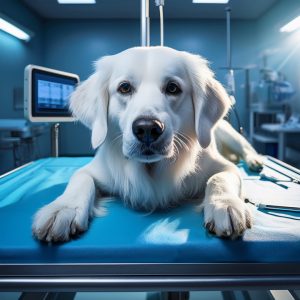
1. Weichteilchirurgie (am häufigsten)
- Kastrationen/Sterilisationen (Ovariohysterektomie, Ovariektomie, Kastration beim Rüden):
→ Mit Abstand die häufigsten planbaren Eingriffe. - Tumorentfernungen (Exzisionen von Hauttumoren, Mammatumoren, Lipomen):
→ Sehr häufig, da Hauttumoren bei Hunden eine der am weitesten verbreiteten Neoplasien darstellen. - Wundversorgung (z. B. nach Bissverletzungen, Verkehrsunfällen):
→ Zahlreich aufgrund der hohen Inzidenz von Traumata. - Fremdkörperentfernung aus Magen-Darm-Trakt:
→ Besonders bei jungen und neugierigen Hunden.
Orthopädische Chirurgie
- Kreuzbandriss (Cranial Cruciate Ligament Rupture, CCLR):
→ Der häufigste orthopädische Eingriff, besonders bei mittelgroßen bis großen Rassen. - Patellaluxation:
→ Vor allem bei kleinen Rassen (z. B. Chihuahua, Yorkshire Terrier). - Frakturversorgung (Osteosynthese):
→ Bedingt durch Traumata, ebenfalls sehr häufig. - Hüftgelenks-Operationen (Femurkopfresektion, Hüftprothese):
→ Seltener als Kreuzbandchirurgie, aber relevant bei Hüftdysplasie.
Notfall- und Spezialoperationen
- Magendrehung (Gastric Dilatation-Volvulus, GDV):
→ Akuter Notfall, typisch bei großen Hunderassen. - Kaiserschnitt:
→ Besonders bei brachycephalen Rassen (z. B. Bulldoggen). - Augenoperationen (z. B. Entropium-/Ektropiumkorrektur, Entfernung des dritten Augenlids bei Prolaps der Nickhautdrüse).
- Zahnsanierungen und Extraktionen:
→ Statistisch ebenfalls sehr häufig, auch wenn sie oft nicht als „große Chirurgie“ wahrgenommen werden.
Eine Operation, ob Tumorentfernung, Kreuzbandrekonstruktion oder Routinekastration, ist für Tiere und Halter*innen gleichermaßen aufregend.
Wie läuft eine Operation beim Hund ab?
Preliminary Examination:
At the pre-op appointment, the veterinarian takes the medical history (anamnesis). The heart, lungs, mucous membranes, fluid balance (hydration) and body temperature are checked. Depending on the age and any pre-existing conditions, laboratory tests (blood count, serum chemistry) as well as, in the case of conspicuous findings on the heart or lungs, a cardiac ultrasound and X-ray of the chest follow. All findings lead to a classification of the animal to be operated on into a risk class (ASA risk class), which determines the anesthesia plan.
Fasting before Surgery:
Current guidelines recommend a food withdrawal of 6 to 8 hours for healthy adult dogs and cats. Water may be available up to 2 hours before the start of surgery preparations. Puppies, old animals and diabetic patients fast for a shorter time to avoid hypoglycemia.
Individual Anesthesia and Analgesia Plan:
Based on the findings, the surgical team creates a plan for premedication (e.g. dexmedetomidine + opioid), for preemptive analgesia* (opioid + NSAID) and for infusion therapy, which is documented in writing.
A detailed and documented explanation of costs and risks, including rare complications such as allergic reactions or post-operative bleeding, completes the preparations.
* preventing the Pain before it arises
Procedure of an animal operation
Check-in and Premedication:
Typically, the animal is dropped off at the hospital in the morning. After weighing and placing an IV catheter, the animal receives its sedative injection. This reduces anxiety, stabilizes circulation, and lowers the dose of anesthetics required for anesthesia induction.
Anesthesia Induction:
About 20 minutes later, anesthesia is induced intravenously with propofol or alfaxalone. An endotracheal tube (breathing tube in the trachea) secures the airways and serves to supply the anesthetic gas iso- or sevoflurane. These are very well tolerated. The supply of anesthetic gases is very easy to control, so a stable, adequate depth of anesthesia can be ensured.
Monitoring and Anesthesia Risk in Dogs and Cats:
During the entire operation, connected monitoring devices check the most important organ functions. The extent of monitoring measures during anesthesia depends on the risk classification (ASA classification) of the patient. At a minimum, heart rate, respiratory rate, blood oxygen saturation, expiratory CO₂ (carbon dioxide in exhaled air) and body temperature are recorded. The color of the mucous membranes and their blood flow as well as the depth of anesthesia based on reflexes are also monitored at short intervals. For longer procedures, additional parameters, such as blood sugar levels, are monitored. Warm air blankets prevent hypothermia, infusions ensure organ perfusion. Anesthesia monitoring is performed by a veterinarian not involved in the operation (anesthetist) or by a specially trained veterinary assistant. Anesthesia monitoring contributes significantly to a low anesthesia and surgery risk in dogs and cats.
Surgical Technique:
Whenever possible, clinics use minimally invasive methods such as arthroscopy or laparoscopy. Smaller incisions mean less Pain, less blood loss, less risk of infection and significantly faster recovery after surgery. A surgeon’s experience also affects the operating time. The shortest possible operating times are generally associated with fewer complications during and after surgery.
Wake-up Phase
After the last skin suture, the supply of inhalation agents is interrupted. The tube remains until swallowing and eyelid closure reflexes are reliably present. The assessment of Pain using Pain score systems (e.g. Glasgow scale) controls the further administration of Painkillers (post-analgesia). Medications against Vomiting (antiemetics) reduce Nausea and allow early fluid intake. Monitoring of body temperature and corresponding continuous temperature management remain in place until the animal can stand on its own.
Discharge home after surgery
In the case of uncomplicated soft tissue procedures, your dog / cat may already go home on the same day.
You will receive a:
- Medication plan: Analgesics for 3–5 days (orthopedic/oncological up to 14 days), possibly an antibiotic.
- Wound protection: Dogs and cats usually need a neck collar or body.
Recommendations for:
- Environment: Non-slip mats, secured stairs, leash required.
- Feeding after surgery: Small, easily digestible portions as soon as there is no Vomiting.
The aftercare
In order to recognize complications after surgery in a dog or cat in time, you should check the body temperature, appetite, the appearance of the mucous membranes (pink, shiny or pale or clearly reddened) in the first 48 hours.
Complete healing ranges from a few days (castration) to several months (cruciate ligament surgery). Orthopedic patients demonstrably benefit from structured rehabilitation programs. These include passive mobilization, hydrotherapy, massage and laser. Close Pain assessment, weight management and joint-friendly diets prevent chronic complaints.
Warning signs include Fever (>39 C), a weeping Swelling in the wound area, pale gums, apathy, sudden Lameness, or post-operative bleeding. The animal should then be immediately presented at the hospital. The first scheduled follow-up appointment usually takes place one to two days after a major operation. Another check-up is necessary 8 to 10 days after an operation. At this appointment, the sutures or staples will also be removed.
FAQ
- How long does my dog have to fast before surgery? How long does my cat have to fast before surgery?
Healthy adult dogs and cats should fast for 6 – 8 h before surgery; water may be available up to 2 h before surgery. - What is the anesthesia risk in dogs? What is the anesthesia risk in a cat?
For ASA I to ASA II patients, the anesthesia risk is < 0.1%. It increases with heart/lung diseases. Close monitoring reduces complications. - What preliminary examinations does my animal need before the operation?
Always a clinical examination and a blood count. Depending on the findings, X-rays, ultrasound, ECG and further preliminary examinations may be necessary. - How does an animal operation work?
Check-in, premedication, anesthesia induction, sterile procedure, recovery box, discharge. - When can I pick up my animal after the operation?
For uncomplicated soft tissue procedures usually on the same day; otherwise after stabilization. - What do I have to consider after the operation with my dog, with my cat?
Rest, leash obligation, wound protection, temperature control and the consistent administration of the prescribed medications are important aspects for uncomplicated healing after surgery. - From when can my animal eat again after the anesthesia?
As soon as it is awake and able to stand, the swallowing reflex works and does not vomit. For the most part, this is achieved 4 hours after surgery. - How do I protect my dog’s wound after the operation?
Neck collar or OP-Body prevent Licking and biting. Check the wound 2× daily. - What does an animal operation cost in 2025 and is insurance worthwhile?
Depending on the procedure 300 – 3 000 €; OP insurances often cover 60 – 100 %. - How do I recognize complications after the operation and when do I have to go to the vet?
Fever, weeping Swelling, apathy, or pale mucous membranes are Emergencies and should be immediately presented at the hospital.
Summary
Thanks to modern anesthesia, preemptive Pain therapy and strict monitoring during the operation and in the wake-up phase, animal operations are very safe today. With clear preparation and consistent aftercare, owners contribute to minimizing the risk and accelerate healing.
Literature sources
- Lefort-Holguin M, Delsart A, Otis C, Moreau M, Barbeau-Grégoire M, Mellet F, Biourge V, Lussier B, Pelletier JP, Martel-Pelletier J, Troncy E. Efficacy and Safety of a Diet Enriched with EPA and DHA, Turmeric Extract and Hydrolysed Collagen in Management of Naturally Occurring Osteoarthritis in Cats: A Prospective, Randomised, Blinded, Placebo- and Time-Controlled Study. Animals (Basel). 2024 Nov 16;14(22):3298. doi: 10.3390/ani14223298. PMID: 39595350; PMCID: PMC11591455.
- Thunpattranon T, Niyom S, Lekchareonsuk C, Kasemsuwan S, Mama K. Perioperative pain management in dogs and cats: Attitudes and practices among Thai veterinarians. Vet Anaesth Analg. 2025 Jan-Feb;52(1):98-109. doi: 10.1016/j.vaa.2024.11.004. Epub 2024 Nov 13. PMID: 39616117.
- Vendramini THA, Marchi PH, Olivindo RFG, Pedrinelli V, Amaral AR, de Miranda MS, Príncipe LA, Cesar CGL, Zafalon RVA, Perini MP, Lima LOC, Balieiro JCC, Brunetto MA. Exploring the efficacy and optimal dosages of omega-3 supplementation for companion animals. Nutr Res Rev. 2025 Jun 11:1-47. doi: 10.1017/S0954422425100115. Epub ahead of print. PMID: 40495687.
- Barbeau-Grégoire M, Otis C, Cournoyer A, Moreau M, Lussier B, Troncy E. A 2022 Systematic Review and Meta-Analysis of Enriched Therapeutic Diets and Nutraceuticals in Canine and Feline Osteoarthritis. Int J Mol Sci. 2022 Sep 8;23(18):10384. doi: 10.3390/ijms231810384. PMID: 36142319; PMCID: PMC9499673.
- Tedesco DEA, Guerrini A. Use of Milk Thistle in Farm and Companion Animals: A Review. Planta Med. 2023 May;89(6):584-607. doi: 10.1055/a-1969-2440. Epub 2022 Oct 27. PMID: 36302565; PMCID: PMC11961297.
- Stockman J. Nutrition and Aging in Dogs and Cats. Adv Exp Med Biol. 2024;1446:203-215. doi: 10.1007/978-3-031-54192-6_9. PMID: 38625530.
- Romero B, Susperregui J, Sahagún AM, Altónaga JR, López C, de la Puente R, Rodríguez JM, Vázquez M, Díez R. Perioperative drug management in non-critical companion animals: a retrospective study at a Spanish veterinary teaching hospital (2018-2022). Vet Q. 2025 Dec;45(1):1-17. doi: 10.1080/01652176.2025.2513965. Epub 2025 Jun 6. PMID: 40476354; PMCID: PMC12147486.