
Home » Diseases » Emergencies / First Aid for Dogs & Cats – General Information » Emergencies / First Aid A-Z » Foreign Object in the Eye (Ocular Foreign Body)
Foreign Object in the Eye (Ocular Foreign Body)
Definition
Foreign body in the eye
A foreign body in the eye is present when particles such as sand, awns or splinters adhere to or penetrate the conjunctiva or cornea. It leads to Pain, severe tearing, blinking and possibly corneal damage. If left untreated, inflammation, ulcer and vision loss threaten.
Foreign bodies in the eye in dogs and cats are a common ophthalmological emergency. These are foreign objects that can penetrate into various structures of the eye. The eye of our pets is a complex sensory organ that is protected from external influences by several natural protective mechanisms such as eyelids, eyelashes, tear fluid and the blink reflex. The anatomy of the animal eye differs in some aspects from the human eye, which must be taken into account when considering eye injuries. For example, dogs and cats have a third nictitating membrane (membrana nictitans), which serves as additional protection, but can also be affected by foreign bodies themselves.
Foreign bodies can lie superficially on the conjunctiva or cornea, be located under the eyelid or the nictitating membrane, or penetrate into deeper structures of the eye. Depending on the location, type of foreign body and duration of stay in the eye, damage of varying severity can occur. Animals with protruding eyes such as brachycephalic breeds (e.g. pug, Persian cat) are particularly at risk, as their eyes are less protected by the bony orbital cavity.
Causes
Foreign bodies can easily get into the eye. Smaller foreign bodies are flushed out by the tear fluid and blinking alone and do not require treatment.
Foreign bodies include in particular:
- Insects
- Grains of sand
- Plant parts
More detailed:
The causes of foreign bodies in the eye are varied and strongly related to the animal’s living environment and activities. The most common foreign bodies include:
Organic materials such as blades of grass, awns, plant parts, wood splinters or insects pose a particular hazard, as they often carry bacteria or fungal spores and can therefore cause infections in addition to mechanical damage. These foreign bodies occur particularly frequently in spring and summer, when dogs roam through tall grass or rummage in the undergrowth.
Inorganic materials such as grains of sand, dust, pebbles or metal splinters can also get into the eye, especially when driving with the window open or in windy conditions. These particles often cause scratches on the cornea, which can lead to serious complications if left untreated.
Chemical substances such as cleaning agents, fertilizers or other household chemicals can get into the eye if handled improperly and cause severe burns. Particular caution is required here, as the damage is often more serious than with mechanical foreign bodies.
Breed-specific factors also play a role. Dog and cat breeds with protruding eyes or flat faces (brachycephalic breeds) have an increased risk of a foreign body in the eye, as their eyes are less protected by the skull structure. In addition, some breeds such as Cocker Spaniels or Bloodhounds have drooping eyelids, which can promote the penetration of foreign bodies.
Symptoms
Foreign body in the eye in dogs and cats
Typical Symptoms:
- Sudden blinking/squinting,
- Rubbing
- Tears of the eye
- Conjunctival Hyperemia
- Keeping the eye closed
- Sensitivity to light, possibly visible foreign body
- Corneal surface rough/cloudy
Alarm signs:
If the foreign body penetrates the structures of the eye, the symptoms intensify and it comes to
- Severe pain, corneal opacity or visible defect (ulcer)
- Purulent discharge, significant Swelling
- Foreign body stuck (e.g. awn)
- Pupil change, vision deterioration
Escalation/course:
- Superficial irritation can turn into Ulzeration within hours
- Increasing discharge/pain after 6–24 h → infection/ulcer more likely
- Deep injury → risk of perforation, especially with persistent rubbing
The symptoms of foreign bodies in the eye can vary depending on the type, size and location of the foreign body, but are usually clearly recognizable. One of the classic signs is increased tearing (epiphora), which is a natural reaction of the body to flush out the foreign body. The conjunctiva often appears reddened and inflamed (conjunctivitis), which is due to the irritation caused by the foreign body.
Affected animals often show noticeable blinking or keep the eye partially or completely closed (blepharospasm) to reduce Pain and avoid further irritation. Typically, they try to rub the affected eye with their paw or rub their head on furniture or the floor, which often makes the situation worse and can lead to additional injuries.
If a foreign body remains for a longer period of time, the symptoms can worsen. There may be significant Swelling of the eyelids (blepharitis), and the cornea may become cloudy (keratitis). In advanced cases, purulent secretion can form, indicating a bacterial secondary infection. Particularly in the case of perforating foreign bodies, inflammation of the inner eye structures (uveitis) can occur, recognizable by a change in pupil size or shape and a discoloration of the iris.
Some animals may also experience increased sensitivity to light (photophobia) and specifically seek out darker areas. In severe cases, the animal may show signs of general malaise, such as reduced appetite or reduced activity, especially if Pain is severe or an infection is present.
Special considerations for cats
Rubbing or cleaning will worsen the injury, so apply a protective collar or cone early on.
First Aid
- Wash your hands with soap and water.
- If the foreign body is larger and you can see it clearly, such as a blade of grass in the area of the conjunctiva, you can try to grasp it and remove it or flush it out with warm water. Here, too, a sterile packaged syringe can be helpful, with which you repeatedly draw up slightly warm, clean tap water and flush it into the eye under gentle pressure.
- Try to keep your pet’s eyelids open.
- Do not rub the eye, do not put pressure on the eyeball and do not use any objects to remove a foreign body from the eye.
- Prevent your pet from rubbing its eye with its paws. Use a collar if necessary.
When should you see a vet sooner?
Urgency changes from orange to → red if there is a visible perforation, severe Bleeding, globe prolapse, or severe trauma.
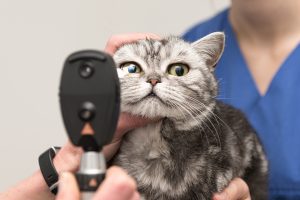
If you notice a lodged foreign body, a distinctly red eye, a significantly inflamed conjunctiva, or purulent discharge in the corner of the eye, an immediate, careful, professional examination of the eyes is also necessary (Fig.).
Diagnosis
The diagnosis of foreign bodies in the eye requires a thorough ophthalmological examination. First, the veterinarian performs a general assessment of the affected eye, paying attention to signs such as redness, Swelling, discharge, and blepharospasm. To allow a detailed examination, a local anesthetic in the form of eye drops is often administered, which relieves the Pain and allows the animal to open the eye.
Slit-lamp examination is an essential diagnostic tool that allows an enlarged, three-dimensional view of the eye. With this technique, even the smallest foreign bodies or injuries to the cornea can be identified. A fluorescein dye test is often performed to assess corneal integrity. A fluorescent dye is applied to the eye, which adheres to damaged areas of the cornea and glows green under blue light. This method is particularly valuable for detecting corneal injuries caused by foreign bodies.
If a deeper foreign body is suspected or in more complex cases, further imaging procedures such as ultrasound or, in specialized facilities, even optical coherence tomography (OCT) can be used. These methods allow a detailed representation of the inner eye structures and can help in the localization of foreign bodies that are not visible superficially.
In some cases, especially if an infection is suspected, swabs can be taken for microbiological examination. This is important to identify the causative pathogen and initiate targeted antibiotic therapy. The diagnosis must also take into account differential diagnoses such as primary conjunctivitis, allergic reactions or other eye diseases that can cause similar symptoms.
Further veterinary measures
Introduce your animal to a veterinarian.
Superficial foreign bodies can usually be removed under local anesthesia. Foreign bodies that have penetrated into the interior of the eye must be removed surgically.
The treatment of foreign bodies in the eye depends on the type, size and location of the foreign body as well as the extent of the damage caused. In the case of superficial foreign bodies on the conjunctiva or cornea, the first measure is careful removal. This is done in the veterinary practice under local anesthetic using special instruments such as moist cotton swabs, fine tweezers or irrigation with sterile saline solution. For deeper-seated or larger foreign bodies, sedation or general anesthesia may be necessary to ensure safe removal.
After the removal of the foreign body, drug therapy is usually carried out to prevent secondary infections and promote healing. Antibiotic eye drops or ointments are prescribed to prevent or treat bacterial infections. In the case of severe Inflammatory conditions, anti-inflammatory drugs such as corticosteroids can also be used, but these must be used with caution, especially in the case of existing corneal defects.
Pain management is an important aspect of therapy. In addition to local anesthetics for examination and removal of the foreign body, systemic painkillers can be prescribed to provide relief to the animal. In some cases, a neck brace is recommended to prevent the animal from rubbing its eye and causing further damage.
For perforating injuries or foreign bodies that have penetrated deeper structures of the eye, a surgical intervention may be necessary. These procedures are ideally performed by a veterinary ophthalmology specialist. Depending on the severity of the injury, a corneal suture, conjunctival flap surgery, or, in severe cases, even removal of the eye (enucleation) may be necessary if it can no longer be saved.
Prognosis and aftercare
The prognosis for foreign bodies in the eye depends largely on several factors: the type and size of the foreign body, the duration of its stay in the eye, the depth of the injury and the speed of veterinary care. Superficial foreign bodies that are removed early generally have an excellent prognosis. The cornea has a remarkable ability to regenerate, and small superficial injuries often heal completely within a few days without leaving any permanent damage.
However, deeper injuries or prolonged retention of the foreign body can lead to complications. Corneal scars can remain and, depending on their location and extent, impair vision. Especially in the case of infections with aggressive pathogens or in the case of foreign bodies that release chemical substances, healing can be delayed and the risk of permanent damage increases.
Aftercare plays a crucial role in the success of healing. Regular check-ups with the veterinarian are important to monitor the healing process and adjust the therapy if necessary. The correct administration of the prescribed medication is essential – eye drops or ointments usually have to be applied several times a day, which can be a challenge for pet owners. A precise instruction on the correct technique of drug administration is therefore important.
During the healing phase, the animal should be protected from further injuries. A neck brace prevents the animal from scratching the eye, and activities that could increase the risk of renewed eye injuries should be restricted. For brachycephalic breeds or animals with recurring eye problems, long-term preventive measures such as regular eye check-ups and special care measures may be recommended.
Summary
Foreign body in the eye is a common ophthalmology emergency in dogs and cats that requires quick action. The range of possible foreign bodies ranges from harmless dust particles to dangerous perforating objects such as thorns or metal splinters. Typical symptoms include increased tearing, Conjunctival hyperemia, squinting, and partially or completely keeping the eye closed. If a foreign body remains for a longer period of time, the symptoms can worsen to Swelling, corneal opacity, and purulent discharge.
Diagnostic clarification by a veterinarian is essential and includes a thorough eye examination, often supported by special techniques such as the fluorescein test or slit lamp examination. The Therapy depends on the type and location of the foreign body and ranges from simple removal under local anesthesia to complex surgical procedures for deeper foreign bodies. A subsequent drug treatment with antibiotics and anti-inflammatory agents is necessary in most cases.
The Prognosis is mostly good with early treatment, with the healing time depending on the severity of the injury. Careful aftercare with regular medication and protection from further injury is crucial for a full recovery. Preventive measures such as avoiding high-risk situations and regular eye check-ups can help prevent future incidents.
Outlook on current research
Veterinary research in ophthalmology is continuously advancing, which also affects the treatment of foreign bodies in the eye. Innovative imaging techniques such as high-resolution optical coherence tomography (OCT) enable more precise diagnostics and localization of foreign bodies, especially in the case of deeper or very small objects. This technology, originally developed in human medicine, is increasingly finding its way into specialized veterinary facilities and significantly improves diagnostic capabilities.
In the field of Therapy, new biomaterials are being researched that can serve as temporary or permanent corneal substitutes. These could be used in the future for severe injuries caused by foreign bodies to repair the cornea and maintain vision. The development of special contact lenses for animals is also progressing. These can not only serve as protection for the healing cornea, but also as carriers for drugs that are continuously released over a longer period of time.
Research into regenerative therapies, including the use of stem cells and growth factors, shows promising results in the treatment of corneal injuries. These approaches could shorten healing time and reduce the risk of Scar tissue formation in the future. Furthermore, new antibiotics and anti-inflammatory substances are being developed that are more specific and cause fewer side effects.
Another important area of research is the development of preventive measures, especially for predisposed breeds. This includes both improved protective devices for animals at increased risk and genetic studies aimed at reducing the breeding of animals with extreme anatomical features that can lead to eye problems.
Frequently asked questions (FAQs)
- How do I recognize if my pet has a foreign body in its eye?
Look for increased tearing, redness of the eye, frequent blinking, rubbing the eye with the paw, or a partially or completely closed eye. These symptoms indicate Pain or discomfort and should be taken seriously. - Can I remove a visible foreign body from my pet’s eye myself?
In the case of superficial, easily visible foreign bodies, you can try to remove them by carefully rinsing with lukewarm, sterile saline solution. However, never use tweezers or other instruments and do not put pressure on the eyeball. In case of Uncertainty / disorientation or if the foreign body is not easy to remove, seek veterinary help immediately. - How urgent is a visit to the vet if a foreign body is suspected in the eye?
A foreign body in the eye should be considered an emergency. The longer a foreign body remains in the eye, the greater the risk of complications such as infections or permanent damage. Therefore, seek veterinary help within hours if possible. - Which breeds are particularly susceptible to foreign bodies in the eye?
Brachycephalic breeds such as pugs, bulldogs, Persian cats or Pekingese have an increased risk due to their protruding eyes and flat face shape. Dog breeds with drooping eyelids such as Cocker Spaniels or Bloodhounds are also more susceptible to foreign bodies under the eyelids. - How long does healing take after a foreign body has been removed from the eye?
The healing period depends on the severity of the injury. Superficial scratches often heal within 3–5 days, while deeper injuries or infections can take weeks to heal completely. Regular follow-up checks with the veterinarian are important to monitor the healing process. - Can an untreated foreign body in the eye lead to blindness?
Yes, untreated foreign bodies can lead to serious complications such as corneal ulcers, infections or inflammation of the inner eye structures, which can potentially lead to blindness. - How do I administer eye drops correctly to my pet?
Gently fix your pet’s head, pull the lower eyelid down slightly and drip the prescribed amount into the resulting conjunctival sac, not directly onto the cornea. Avoid touching the dropper tip with the eye or fur to prevent contamination. - How can I prevent foreign bodies in my pet’s eye?
Avoid driving with the windows wide open, keep your pet back in strong winds or dusty environments, and check their eyes regularly, especially after walks through tall grass or undergrowth. Regular eye care may be useful for predisposed breeds. - Are certain seasons particularly risky for foreign bodies in the eye?
Yes, there is an increased risk in spring and summer due to grasses, pollen and insects. Grass awns, which can easily get caught in the eye, are particularly dangerous. In autumn, seeds and dry plant parts can be problematic, while in winter road salt and grit can cause eye irritation. - Can my animal fully recover after a foreign body injury to the eye?
With early and appropriate treatment, the prognosis for a full recovery is good for most foreign body injuries. Even if scars remain on the cornea, they often do not significantly impair vision, provided they are not located directly in the visual center.
Literature
- Professional Association of Ophthalmologists of Germany e. V., & German Ophthalmological Society e. V. (2011). Guideline No. 8: Injuries to the eye and its adnexa (with modification regarding burns in February 2024).
- Featherstone, H. J., & Heinrich, C. L. (2021). Ophthalmic examination and diagnostics. In K. N. Gelatt, G. Ben-Shlomo, B. C. Gilger, D. V. H. Hendrix, T. J. Kern & C. E. Plummer (Hrsg.), Veterinary ophthalmology (6. Aufl., S. 533–613). Wiley-Blackwell.
- Gelatt, K. N. (2013). Veterinary ophthalmology (5. Aufl.). Wiley-Blackwell.
- Gould, D., & McLellan, G. J. (2022). BSAVA manual of canine and feline ophthalmology (4. Aufl.). British Small Animal Veterinary Association.
- Ledbetter, E. C., & Gilger, B. C. (2021). Diseases and surgery of the canine cornea and sclera. In K. N. Gelatt, G. Ben-Shlomo, B. C. Gilger, D. V. H. Hendrix, T. J. Kern & C. E. Plummer (Hrsg.), Veterinary ophthalmology (6. Aufl., S. 1082–1164). Wiley-Blackwell.
- Löwe, G., & Löwe, O. (2021). Notfälle bei Hund und Katze – Ein tierärztlicher Ratgeber (208 S.). Kynos-Verlag.
- Maggs, D. J., Miller, P. E., & Ofri, R. (2017). Slatter’s fundamentals of veterinary ophthalmology (6. Aufl.). Elsevier.
- Merck & Co. (2020). Merck veterinary manual (11th ed.). Merck Publishing.