


Home » SOP Library » SOP: Module 1 – Patient Admission and Triage
Veterinary Emergency SOP Library
Module 1: Patient Admission and Triage
Standardized process for patient admission and triage
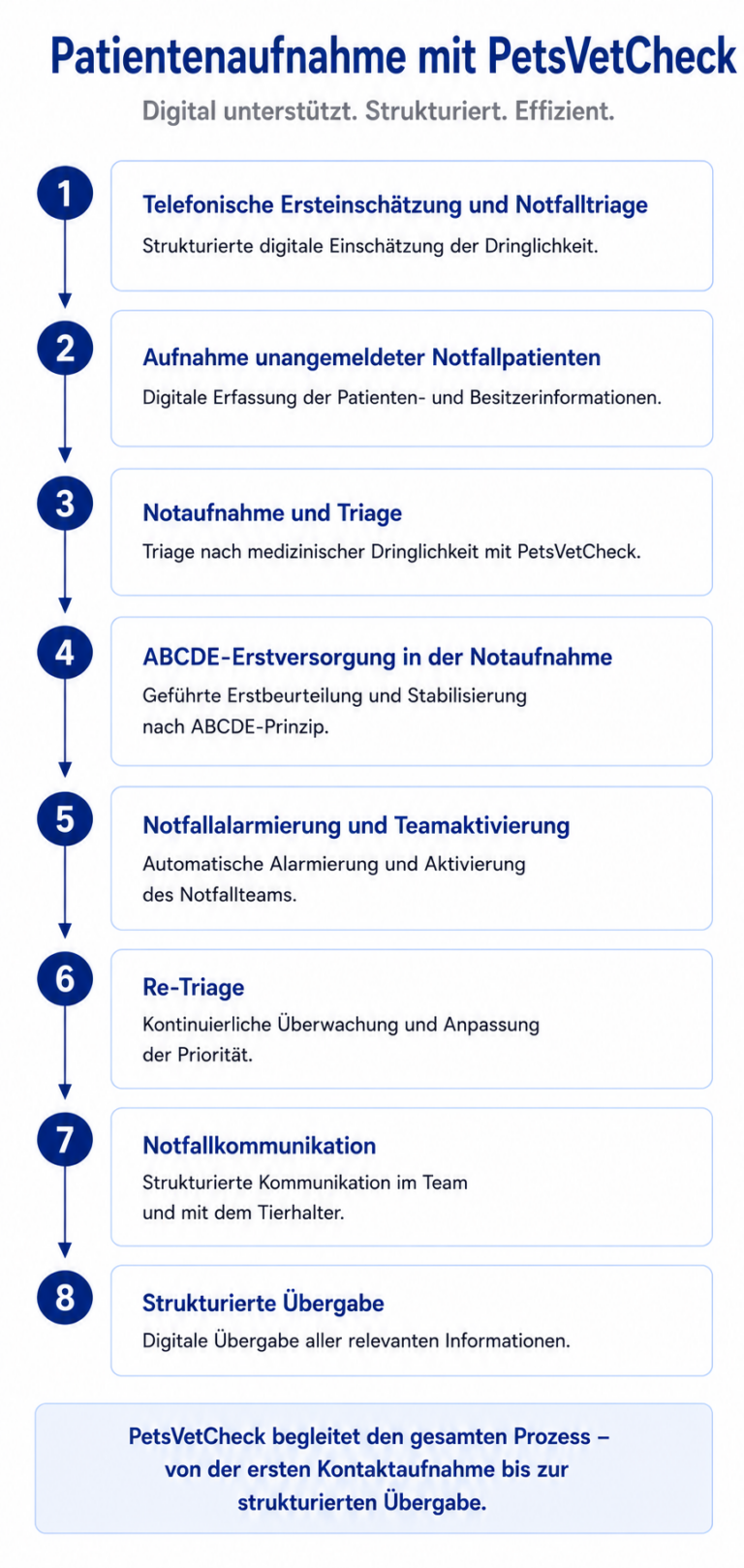
The SOPs in Module 1 (124 pages) together form a continuous, logically structured process for veterinary emergency care. From first contact through telephone initial assessment, patient admission and prioritization, to ABCDE primary care, team activation, re-triage, and structured handover, each process step integrates seamlessly. This creates a standardized clinical workflow that supports safe, efficient, and traceable care for emergency patients.
SOP 1: Emergency Admission and Triage
Key message:
Structured triage forms the foundation for safe, priority-based care of emergency patients. It enables early identification of life-threatening conditions and ensures that every patient is treated according to their medical urgency.
Scope: 28 pages
SOP 2: Telephone Assessment and Emergency Triage
Key message:
Telephone initial assessment serves to identify potential emergencies early and to safely guide the next steps. Through structured questioning, life-threatening situations are recognized, appropriate recommendations are given, and unnecessary delays are avoided.
Scope: 44 pages
SOP 3: Structured Handover
Key message:
A standardized patient handover ensures complete and traceable transfer of all relevant information. It reduces information loss, increases patient safety, and supports continuous emergency care.
Scope: 12 pages
SOP 4: Re-triage
Key takeaway:
The condition of emergency patients can change at any time. Regular re-triage ensures that clinical deterioration is detected early and treatment priority is adjusted in a timely manner.
Scope: 7 pages
SOP 5: Emergency Communication
Key message:
Clear, structured, and situation-appropriate communication is an essential component of emergency care. It improves collaboration within the treatment team, provides orientation for pet owners, and contributes significantly to patient safety.
Scope: 18 pages
SOP 6: Admission of Unannounced Emergency Patients
Key message:
For unannounced emergency patients, medical initial assessment always takes priority over administrative procedures. Immediate triage enables early recognition of critically ill patients and prevents avoidable delays.
Scope: 4 pages
SOP 7: ABCDE Primary Care in the Emergency Room
Key message:
The ABCDE approach enables systematic, priority-based initial care of critically ill or injured patients. Life-threatening conditions are identified and immediately treated in a standardized sequence.
Scope: 6 pages
SOP 8: Emergency Alerting and Team Activation
Key message:
A standardized emergency alert ensures that the appropriate treatment team is available early, completely, and in a coordinated manner. Clear alert pathways and defined roles shorten response time and improve quality of care in time-critical situations.
Scope: 5 pages
Process diagram Module 1: Patient admission and triage
Would you like to explore using PetsVetCheck?
"*" indicates required fields